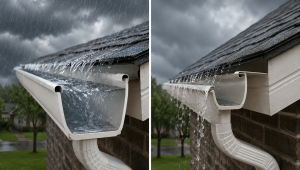

Seamless gutters cost more up front than sectional gutters. For most Dallas-Fort Worth homes, they are still the better buy. The reason is simple. Fewer joints mean fewer places for water to escape, and North Texas weather punishes joints hard.
This guide explains what seamless gutters are, how they get made, what they cost, and how long they last. You also get a straight verdict at the end, plus answers to the questions DFW homeowners ask us most.
What are seamless gutters? A plain-English definition
A seamless gutter is a gutter run formed from one continuous coil of metal, cut on site to the exact length of your roofline, with no joints between the corners.
Sectional gutters work differently. They ship in pre-cut pieces, usually 10 feet long. An installer overlaps those pieces and seals each overlap. Every overlap is a joint. Every joint depends on sealant. Sealant is the part that fails first.
One honest clarification: seamless does not mean zero seams. You still get connections at inside corners, outside corners, end caps, and downspout outlets. What you eliminate is the row of joints every 10 feet along each straight run.
On a 180-foot home, that difference is real:
- Sectional: roughly 17 in-line joints, plus corners and outlets
- Seamless: typically 6 to 10 connections total, all at corners and outlets
How seamless gutters are made: on-site custom fabrication
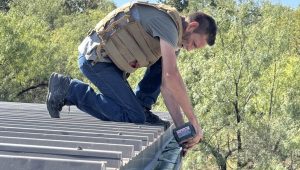
Seamless gutters cannot be bought off a shelf. They get built at your house, on the day of the job, from a coil of painted aluminum.
Here is the process our crews follow:
- Measure the roofline. We record every run, corner, and pitch change to the inch.
- Load the coil. A roll-forming machine sits on the truck or trailer, loaded with your chosen color.
- Form the run. The machine presses flat coil into a finished K-style profile at the exact length needed.
- Set the drip edge. We position drip edge so water enters the gutter instead of soaking the fascia behind it.
- Hang and pitch. Hidden hangers go into solid wood, and each run is pitched toward its downspout.
- Seal and test. Corners, end caps, and outlets get sealed, then we run water to confirm drainage.
The roll former is the reason sectional gutters exist at all. That machine costs thousands of dollars. It also takes training to run well. So big-box stores sell 10-foot pieces instead.
At Gutter Nation, every run is built for one specific house. We also send our own W-2 installers, not rotating subcontractors. Read more about how our crews work and what that means for your job site.
Seamless vs. sectional gutters: full comparison table
| Factor | Seamless gutters | Sectional gutters |
| How they are made | Formed on site from one coil | Pre-cut 10-foot pieces, joined on site |
| Joints on a 180-ft home | About 6 to 10 | About 20 or more |
| Main leak point | Corners and outlets | Every lap joint |
| Debris snag points | Corners only | Every lap joint and screw head |
| Installed cost, aluminum | Roughly $6 to $20 per linear foot | Roughly $4 to $12 per linear foot |
| Expected lifespan, aluminum | 20 years or more | 20 years, if seams are maintained |
| DIY friendly | No, needs a roll former | Yes |
| Repair method | Patch or replace one run | Replace or reseal individual pieces |
| Appearance | One clean line along the roof | Visible joints every 10 feet |
Cost figures reflect national installed averages published by HomeGuide, Angi, and This Old House in 2026. Ranges vary widely by region, home height, and roof pitch. A written on-site estimate is the only accurate number.
Pros and cons of seamless gutters
Pros
- Fewer leak points. Straight runs carry no in-line joints at all.
- Less snagging. Leaves and shingle grit catch on lap joints and screw heads, and seamless runs have neither.
- Exact fit. Runs match your roofline instead of forcing your roofline to match stock lengths.
- Cleaner look. One unbroken line reads better than a joint every 10 feet.
- Fewer service calls. Less sealant means fewer things to reseal over 20 years.
Cons
- Higher up-front cost. Expect to pay roughly 30% to 50% more than sectional.
- No DIY option. You need a roll former and a trained operator.
- Harder spot repairs. Damage in the middle of a long run can mean replacing that whole run.
- Still dents. Aluminum is soft. Hail and ladders leave marks regardless of seams.
Why DFW heat is hard on gutter seams
North Texas differs from most of the country here. This is the strongest case for going seamless.
Metal expands when it heats and contracts when it cools. Aluminum moves about 0.0000128 inch per inch for every degree Fahrenheit. That sounds tiny. Run the math over a full gutter and it stops being tiny.
A 40-foot aluminum run moves roughly 0.6 inch across a 100°F temperature swing. A single 10-foot sectional piece moves about 0.15 inch over that same swing.
DFW delivers that swing every single year. According to National Weather Service data for DFW Airport (1991 to 2020 normals), the area averages:
- 20.2 days per year at 100°F or hotter
- 29.2 nights per year at 32°F or colder
- 46.3 thunderstorm days per year
- 37.01 inches of rain per year
The record high at DFW is 113°F, set in June 1980. The record low is -8°F, set in February 1899. Your gutters live through that entire range.
Now picture a sectional run. Every 10 feet, two pieces of aluminum slide against each other and the sealant between them stretches and compresses. That happens daily through summer, then reverses through winter. Sealant is elastic, but it is not immortal. Joints are where DFW gutters start dripping.
A seamless run moves too. The difference is that it moves as one piece, with no sealed lap joints in the middle to work loose.
How to tell if your gutters are sectional
Most DFW homeowners have never checked. You can do it from the ground in two minutes.
Walk the perimeter and look at the long straight runs. Watch for these signs:
- A visible line every 10 feet. Sectional pieces overlap. The lap shows as a slight step or a darker band.
- Rivets or screw heads mid-run. Seamless runs carry no fasteners between the corners.
- Dark streaks on the siding. Water escaping a bad joint stains the wall right below it.
- Dried caulk at the joints. White or gray sealant squeezed out of a lap is a giveaway.
- Drips during light rain. A gutter that drips when it is barely raining has an open seam.
Found two or more? Your gutters are probably sectional and already leaking. Worth a closer look before storm season.
Seamless gutter cost vs. long-term value
Seamless aluminum runs roughly $6 to $20 per linear foot installed nationally. Sectional aluminum runs roughly $4 to $12 per linear foot. Most DFW homes need between 120 and 250 linear feet.
Take a 180-foot home and use mid-range numbers:
- Seamless at $12 per foot: about $2,160
- Sectional at $8 per foot: about $1,440
- Difference: about $720
Spread that $720 across a 20-year service life and it works out to about $36 per year. One service call to reseal failing joints usually costs more than a single year of that difference. Two calls erase it.
That math is why we install seamless as standard. The premium is small, and it buys you the removal of the most common failure point in the whole system.
Several things move your real number:
- Linear footage and number of stories
- Roof pitch and access difficulty
- Number and size of downspouts
- Gutter size, since 6-inch costs more than 5-inch
- Fascia rot repair, if any is found
- Old gutter removal and haul-off
We give a written quote after measuring, so you see the real figure before anything is ordered. Ask for a free gutter estimate and we will walk the roofline with you.
How long do seamless gutters last?
The National Association of Home Builders studied this. Its Study of Life Expectancy of Home Components puts aluminum gutters at 20 years. Aluminum downspouts get 30 years. Copper gutters last 50 years or more.
Those numbers assume the system stays clean and drains properly. In practice, three things end a DFW gutter early:
- Clogs. Standing water adds weight, pulls hangers loose, and rots fascia. Oak, pecan, and cedar elm debris fill gutters fast here.
- Hail. Aluminum dents. Severe hail can flatten a run outright.
- Failed seams. On sectional systems, this is usually first.
Seamless does not extend the life of the metal. It removes the third failure mode almost entirely. Clean seamless aluminum often reaches the top of that range. Sectional systems need resealing along the way.
Twice-yearly gutter cleaning protects the investment. On tree-heavy lots, gutter guards cut how often that work is needed.
Size matters as much as seams
Going seamless does not help if the gutter is too small for the storm. Sizing is a separate decision, and it matters in North Texas.
SMACNA publishes the sizing tables the trade uses. At a 4-inch-per-hour rain rate, a 5-inch K-style gutter drains about 5,520 square feet of roof. A 6-inch K-style drains about 7,960 square feet. That is roughly 44% more capacity.
Downspouts matter just as much. A 2×3 downspout serves about 600 square feet of drainage area. A 3×4 downspout serves about 1,200 square feet.
DFW storms arrive fast. The single-day rainfall record at DFW Airport is 8.11 inches, set in September 2018. That is why we install 6-inch K-style gutters paired with oversized 3×4 downspouts as our standard, not as an upgrade.
You can review available profiles and finishes on our gutter colors and styles page.
So, are seamless gutters worth it? The verdict
Yes, for most DFW homes. The premium over sectional is roughly $500 to $900 on a typical house. That buys you about 17 fewer leak points on a 180-foot roofline. In a climate that swings from 100°F afternoons to freezing nights, those joints matter.
Seamless makes the most sense if:
- You plan to stay in the home more than five years
- Your roofline has long straight runs
- Your current gutters leak or stain the siding at the joints
- You have mature oaks or pecans dropping debris
Sectional can still make sense in two cases. Short accessible runs on a small structure, like a shed or detached garage, do not gain much from seamless. And a homeowner planning to sell within a year may not recover the difference.
One more thing to weigh. Gutter failure rarely stays a gutter problem. Water that escapes a joint runs down the fascia and behind the siding. In North Texas it also saturates the clay soil next to your slab. That soil swells and shrinks with moisture, which is how drainage problems turn into foundation problems. A $720 decision on gutters sits upstream of much larger repairs.
For everything else in the Metroplex, seamless is the better long-term buy. Still deciding who should do the work? We covered that in our guide on choosing a gutter company or a roofing company.
Seamless gutters FAQ
Are seamless gutters worth the extra cost?
Yes, for most homes. The extra cost is typically 30% to 50%, which lands around $500 to $900 on an average DFW house. That premium removes the in-line joints where most gutter leaks begin.
Do seamless gutters really have no seams?
No. Seamless gutters have no joints along straight runs. They still connect at inside corners, outside corners, end caps, and downspout outlets. A typical home has 6 to 10 of those connections instead of 20 or more.
How much do seamless gutters cost in DFW?
National installed averages for seamless aluminum run about $6 to $20 per linear foot. Most DFW homes need 120 to 250 linear feet. Your actual price depends on footage, stories, roof pitch, downspout count, and any fascia repair. A free on-site measurement gives you the real number.
Are seamless gutters better than sectional gutters?
For leak resistance and maintenance, yes. Seamless runs carry no lap joints, so there is less sealant to fail and less debris snagging. Sectional gutters cost less up front and can be installed DIY.
How long do seamless aluminum gutters last?
The National Association of Home Builders lists a 20-year life expectancy for aluminum gutters and 30 years for aluminum downspouts. Regular cleaning and proper drainage push systems toward the top of that range.
Can seamless gutters be installed on any house?
Almost always. The roll former builds runs to any length the roofline needs. The limits are access and fascia condition. Rotted fascia has to be repaired first, which is why we also handle soffit and fascia repair.
Can you repair a seamless gutter or does the whole run get replaced?
Small holes and loose seals get patched. Significant hail damage or a bent section in the middle of a long run usually means replacing that run. Because runs are fabricated on site, a replacement matches the original exactly.
What size seamless gutters do DFW homes need?
Most North Texas homes should use 6-inch K-style gutters with 3×4 downspouts. A 6-inch gutter carries about 44% more drainage area than a 5-inch, which matters during the high-intensity storms common here.
Get a free seamless gutter quote in DFW
Gutter Nation installs custom seamless gutters across the Dallas-Fort Worth Metroplex. That includes Flower Mound, Southlake, Grapevine, Coppell, Denton, and Fort Worth. Every run is formed on site to your measurements. Our own crew hangs it.
Call us today or request a free gutter estimate. We measure the roofline, check how water drains today, and hand you a written quote. No charge, no pressure.
Ready to move forward? See our seamless gutter installation service page for details, or browse reviews from DFW homeowners.