

Gutter Styles in DFW: Find the Right Profile for Your Home Today
Gutter Nation installs K-style and half round gutters, sized for DFW homes.
What Are K-Style Gutters?
K-style gutters have a flat back and a curved decorative front that mimics crown molding. They are the most common residential gutter in the United States, installed on roughly 80% of American homes. The flat back sits flush against fascia boards. That makes installation faster and hangers more secure.
The other reason K-style dominates is capacity. A K-style gutter holds more water than a half round gutter of the same width. The deeper trough and angled walls give it room to move heavy runoff without overflowing.
We install K-style in two sizes:
5-inch K-style
the residential standard, paired with 2×3-inch downspouts
6-inch K-style
oversized for larger roofs and steeper pitches, paired with 3×4-inch downspouts
5-Inch vs 6-Inch K-Style: Sizing, Capacity, and When to Upgrade
The 5-inch and 6-inch labels refer to the gutter’s width. The capacity difference is bigger than the inch difference suggests.
Spec | 5-Inch K-Style | 6-Inch K-Style |
Water held per linear foot | ~1.2 gallons | ~2.0 gallons |
Max adjusted roof area* | ~5,520 sq ft | ~7,960 sq ft |
Standard downspout | 2×3 inch | 3×4 inch |
Cost premium | Baseline | About $1–$2 more per linear foot |
*Adjusted for roof pitch and local rainfall intensity. Source: SMACNA gutter sizing standards.
Choose 5-inch K-style if your home is single-story, your roof has a moderate pitch between 4/12 and 6/12, and your roof drainage area per gutter run is under about 5,500 sq ft.
Step up to 6-inch K-style if any of these apply:
- Two-story home with a steep roof pitch (7/12 or higher)
- Multiple roof planes funnel water into one gutter run
- Roof valleys dump heavy runoff onto a single section
- You have a history of overflow during DFW thunderstorms
- You plan to add gutter guards, which reduce the effective opening
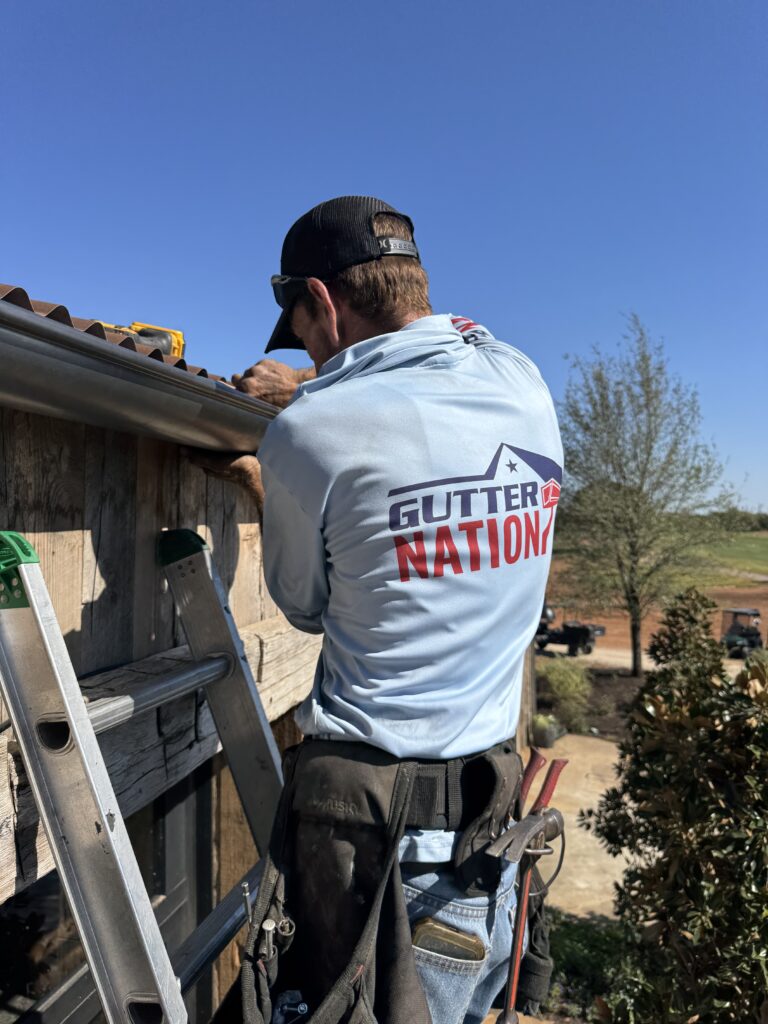
What Are Half Round Gutters?
Half round gutters have a smooth, semicircular profile. They predate K-style by decades and were the standard residential gutter shape on most American homes built before 1950. Today they appear on historic homes, restorations, and high-end custom builds going for a refined classic look.
Two functional advantages set half round apart:
- Smoother debris flow. The curved interior has no corners to trap leaves or shingle grit. Water moves faster, which scours debris through the system. That means less clogging and easier gutter cleaning.
- Lower corrosion risk. Standing water and trapped sludge speed up corrosion. Half round’s smooth interior holds less of both.
Half round suits these architectural styles:
- Historic and heritage homes
- Tudor and English revival
- Spanish revival and Mediterranean
- Craftsman bungalows
- Custom modern homes paired with textured siding like slate, tile, or shake
We install 6-inch half round only. The 6-inch size delivers the capacity DFW rainfall demands while keeping proportions right for the homes that suit this profile. A 5-inch half round caps out around 2,500 sq ft of roof drainage area, which is too restrictive for most homes in our service area.
K-Style vs Half Round: Side-by-Side Comparison
Feature | K-Style | Half Round |
Profile | Flat back, crown molding front | Semicircular |
Water capacity (per width) | Higher | Lower |
Best for architecture | Modern, traditional, brick, stucco | Historic, Tudor, Mediterranean, craftsman |
Self-cleaning | Worse (corners trap debris) | Better (smooth interior) |
Hangers | Hidden, attached to fascia | External brackets, often decorative |
Cost per linear foot | Lower | 50% to 100% higher |
Material options | Aluminum, steel, copper | Aluminum, copper, galvanized steel |
Installation complexity | Standard | Requires specialized brackets |
What Size Gutters Do I Need in DFW?
Three factors set the size:
- Roof drainage area for each gutter run (square footage of the roof feeding that gutter)
- Roof pitch (steeper roofs shed water faster, demanding more capacity)
- Local rainfall intensity (how hard it rains, not just how much)
DFW Rainfall Reality
DFW averages around 38 inches of rain per year. The annual total matters less than how it arrives. North Texas thunderstorms can drop more than 2 inches in a single hour. Spring squall lines and fall cold fronts are the worst offenders. Sizing for the storm, not the average, keeps water off your foundation.
Roof Pitch Factor
Multiply your roof’s drainage area by the pitch factor below to get your adjusted area:
Roof Pitch | Pitch Factor |
Flat to 3/12 | 1.0 |
4/12 to 5/12 | 1.05 |
6/12 to 8/12 | 1.1 |
9/12 to 11/12 | 1.2 |
12/12 or steeper | 1.3 |
Quick Decision Matrix for DFW Homes
Home Type | Adjusted Roof Area | Recommended Size |
Single-story ranch, moderate pitch | Under 5,500 sq ft | 5-inch K-style |
Two-story home, average pitch | 5,500 to 7,500 sq ft | 6-inch K-style |
Large two-story or steep pitch | 7,500 to 10,000 sq ft | 6-inch K-style with extra downspouts |
Custom or oversized roofline | Over 10,000 sq ft | 6-inch K-style with multiple downspouts and zoned runs |
Historic or Tudor home | Under 3,800 sq ft per run | 6-inch half round |
The simplest path is a free on-site assessment. We measure drainage area, calculate pitch, and recommend a size. More common questions are answered on our gutter FAQs page.
Material Options: Aluminum, Copper, and Steel
Both K-style and half round come in multiple materials.
Aluminum is our standard. It’s lightweight, rust-resistant, paintable in dozens of colors, and lasts 20 to 30 years with normal maintenance. It handles Texas heat without warping. For most DFW homes, aluminum is the right call on both K-style and half round.
Copper is available on request, usually for half round on historic or high-end custom homes. Copper develops a natural patina over time and can last 50 to 100 years. Cost runs significantly higher than aluminum.
Galvanized steel is heavier and stronger than aluminum, which makes it more impact-resistant against hail. It costs more and can rust if the coating gets damaged. We discuss steel as an option for homes in the harder-hit hail corridors of DFW.
We do not install box gutters or vinyl gutters. Box gutters are built for commercial roofs and are rarely needed on residential properties in our service area. Vinyl gutters fail fast in Texas heat and UV exposure, so we don’t recommend them.
Built for DFW Storms: Hail, Wind, and Heavy Rain
DFW sits inside one of the most active hail corridors in the United States. Spring brings hailstorms. Summer brings high-wind microbursts. Fall and spring bring the heaviest rainfall events of the year. Gutters here take a beating.
Every Gutter Nation install is built for that:
- Hangers spaced tight for storm load, typically every 24 inches or closer, not the 36-inch maximum some installers use
- Hidden hangers that screw directly into the fascia for maximum hold on K-style runs
- Reinforced miter joints at corners, the most common failure point during heavy runoff
- Properly pitched runs so water moves toward downspouts instead of pooling
- Splash blocks or extensions at downspout outlets to keep water away from the foundation
If your gutters have been torn off by wind, dented by hail, or overflowing during a spring storm, the install was undersized or undersecured. Both are fixable.
Frequently Asked Questions About Gutter Styles
Are K-style or half round gutters better for DFW homes?
K-style is the better fit for most DFW homes. It handles more water per inch of width, costs less, and matches the dominant architectural styles in the area. Half round is the better choice for historic homes, Tudors, Mediterranean revival, and custom builds where the look matters as much as the function.
What's the most popular gutter size in Dallas-Fort Worth?
5-inch K-style is the most-installed gutter in DFW. It fits the typical single-story brick ranch and most newer suburban builds in cities like Plano, Frisco, and Lewisville. 6-inch K-style is the next most common, especially on two-story homes and in neighborhoods with larger custom builds.
Do half round gutters cost more than K-style?
Yes. Half round typically costs 50% to 100% more per linear foot than K-style. The difference comes from specialized brackets, round downspouts, and the fact that half round seamless machines are less common.
Will 6-inch gutters look too big on my house?
Usually not. The visual difference between 5-inch and 6-inch K-style is minor on most homes. On larger two-story houses, 6-inch actually looks more proportional. On a small single-story home with simple roofline, 5-inch typically looks right.
Do you install gutter guards on both styles?
Yes. We install gutter guards on both K-style and half round. Guards reduce the effective gutter opening, which is one more reason to consider 6-inch when adding them.
Get Custom Gutter Installation Across the DFW Metroplex
Gutter Nation installs K-style and half round gutters in Dallas, Fort Worth, Plano, Frisco, Arlington, Southlake, and across our full DFW service area.
Every install includes:
- Free on-site assessment with drainage and pitch calculation
- Color match to your fascia and trim
- Seamless aluminum gutters cut to length on your driveway
- Hangers spaced for Texas storm loads
- Downspout placement that protects your foundation
Contact Gutter Nation for a free quote on K-style or half round gutters in the DFW Metroplex.